


What happens when autistic burnout becomes more than just exhaustion? What scars do the costs of masking, unmet needs, systemic prejudice, overwork, ableism, and erasure accumulating and compounding year after year leave on our cells and our souls?
Let’s talk about Chronic Autistic Burnout.
👐🏽 Welcome Dear Readers! Today, we dive beyond autistic burnout into what decades of pushing beyond capacity really does to a body. Why? To empower you to make choices across all life stages—that’s always the goal here at Roadtrip Thru AllisticLand.
Let’s get into it!
🤿 Want a deeper dive? Look for this scuba emoji. Feel free to skip these bits otherwise. All product links earn affiliate fees that directly support Autastic.
What is Chronic Autistic Burnout?
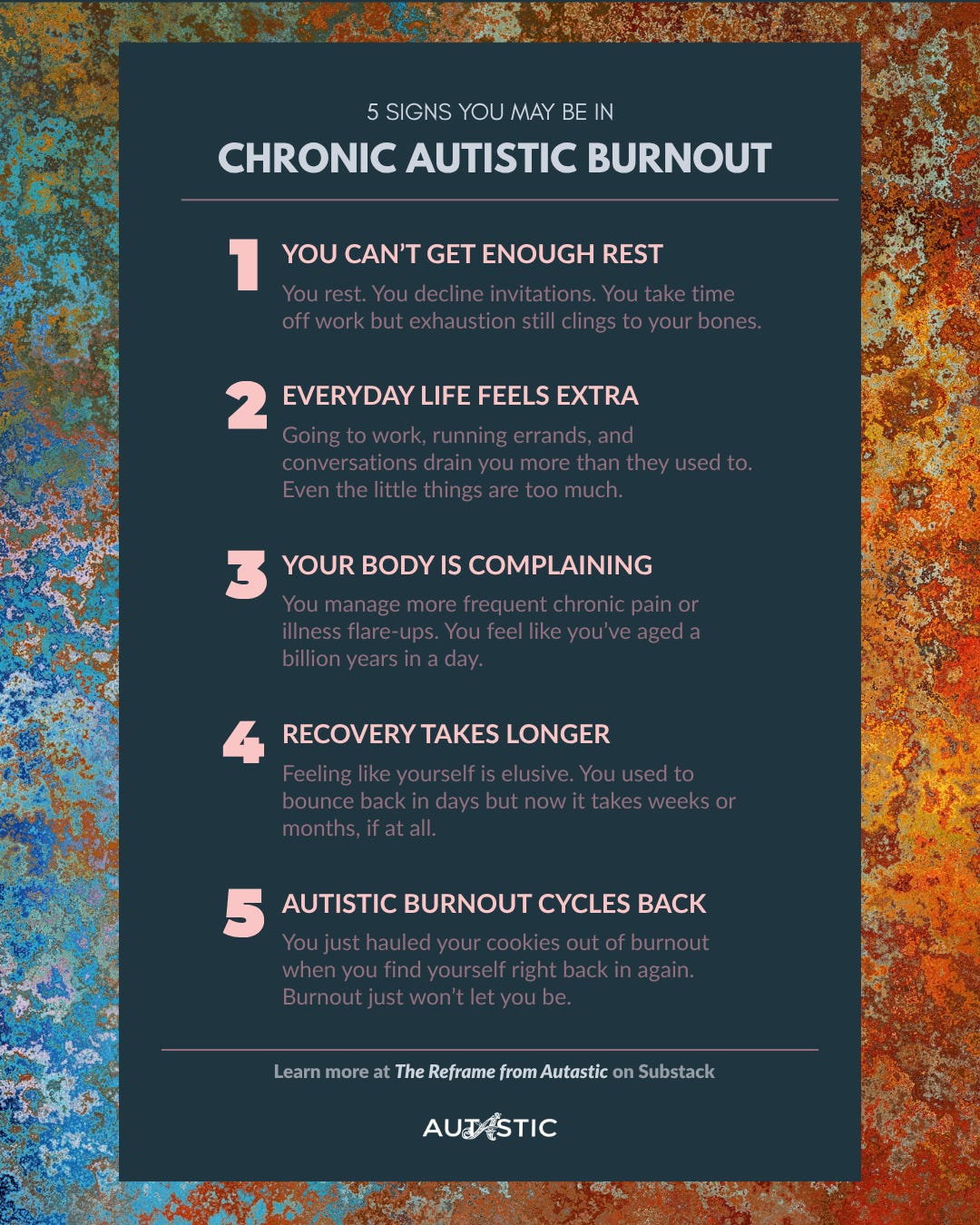
Chronic Autistic Burnout (CAB)—a term I’m coining right here right now as I try to make fetch happen—describes when autistic burnout shifts from occasional collapse to your normal.
If your baseline ability to cope has dropped lower and lower until collapse and recovery no longer feel like distinct cycles and your entire system is operating in depletion, you’ve likely already been living with chronic autistic burnout for some time.
For me, that looked like working out several days a week, hiking for hours, renovating while doing my job one year then over the next few, barely being able to walk to the store and back without needing a day and a half to recover. The exhaustion was to the bone. I was irritable with others and impatient with myself. Why couldn’t I push through as I always had?
Sound familiar?
Why a new label?
The distinction is vital because the “wear and tear” of ongoing stress on our bodies, minds, and spirits—known as 🤿 allostatic load—accumulates as we age.
“Allostatic load predicts health outcomes including cardiovascular disease, functional decline, frailty, and all-cause mortality.”1
CAB damage is measurable in our cells and organs2 and is evidenced, among other things, by persistently diminished capacity. Just as autistic burnout is distinct from non-autistic burnout in cause, experience, and recovery, so too is its chronic form.
Words have power. Naming our distinct experience of Chronic Autistic Burnout means we will eventually gain access to a community of peers, personal narratives, shareable content from self-advocates, inclusion in conversations and initiatives from organizations, more widespread awareness, and eventually change.
That all starts here, with the naming of our shared experience.
👋🏽 I’m right here in it with you
I chose to start Roadtrip Thru AllisticLand with this topic because not only am I living it but too many of our new Autastic Community members arrive at our doors feeling broken when what’s really going on is they’ve been carrying impossible loads for decades.
Why would they realize what’s up when autistic life is still not part of public conversation on an equitable basis? Our members didn’t know they were autistic until well into adulthood—how on earth amidst that level of widespread erasure are we to understand with clarity what’s happening to us?
Aside from the usual constellation of misdiagnoses for autism and autistic burnout, the experience of long-term depletion caused by being autistic in our high-friction world is often interpreted as:
Depression
Overwork
Brain fog
Myalgic Encephalomyelitis/Chronic Fatigue Syndrome (ME/CFS)
Generalized anxiety disorder (GAD)
Hormonal changes such as perimenopause
Thyroid issues
Vitamin deficiencies, and more.
Even ADHD takes the blame. Of course, any and all of these may co-occur but accurately knowing where the exhaustion comes from and how it has changed me is gold.
When you’re in it, like I was and am, you can spend a good part of your very limited energy chasing the wrong explanations and approaches to recovery. Today I better understand why I can’t just “rest” and go do the things I used to and why I’m tired after minimal exertion when all my medical results are a thumbs-up (thankfully🙏🏽). I’ve overcharged my bodily reserves “passing” as allistic for decades without knowing it and now the bill has come due.
🗓️ Next time…
If you’re autistic and in your 30’s and older, your burnout intervals have likely begun to shorten and your recovery periods may feel less and less restorative. If this rings true for you, all is not lost. It’s never too late to feel better.
Next time we’ll look at what the long-term effects of Chronic Autistic Burnout can look like in our bodies, our lives, and in our communities and we’ll get into what we can actually do about it.
🗣️ How are you doing?
Has this introduction to Chronic Autistic Burnout been helpful for you? All of Autastic exists so we can be more connected, less in the dark, and be able to feel, deep down, that we are not The Only. So let’s talk👇🏽
Can you recall your first cycle of autistic burnout? How did you make sense of it at the time?
The last time you were in burnout, what did it take to climb out?
If you already live with inadequate supports that force you to continually overextend, aside from a shipping container of cash, what would you need to reduce the strain and give your long-term health a chance?
Share your experiences in the comments or in our Autastic communities.
If you find Roadtrip Thru AllisticLand makes a difference in your life, I’d could do wonders with your support. Leave a comment to let me know how these words resonated with you, share this post with a friend, upgrade your subscription, or donate. You and I can change the world, one life at a time 💛🧡💚
Need autistic BIPOC community? Come on over to Autastic 💪🏽💪🏾💪🏿

Rodriquez, Erik J., et al. “Allostatic load: Importance, markers, and score determination in minority and disparity populations.” Journal of Urban Health, vol. 96, no. S1, 22 Jan. 2019, pp. 3–11, https://doi.org/10.1007/s11524-019-00345-5.
Gallo, Linda C., et al. “Allostatic load and the assessment of cumulative biological risk in Biobehavioral Medicine.” Psychosomatic Medicine, vol. 76, no. 7, Sept. 2014, pp. 478–480, https://doi.org/10.1097/psy.0000000000000095.
Truth! I love that you called out CAB and also mapped out a brief of why that’s important and how the story can shape really for us. This is very much me, I can track it back at least 38 years to my late teens but it probably goes back farther. I absolutely support the inclusion of this in the Universal Concept Index (UCI). Solidarity friend. ✊🏼